Straight Answers on Home Mood Board Ideas for New Builds
Designing a new home isn’t about piling “pretty” onto a Pinterest board—it’s about making a dozen smart decisions, in the right order, with total confidence. That’s what a mood board does for a custom build: it turns vague taste into a clear plan your builder can price, schedule, and execute. When your style, selections, and priorities are mapped visually, you’ll avoid costly change orders, keep momentum during construction, and end up with a home that lives as good as it looks. If you’re building in Alabama—where indoor–outdoor living, humidity, and severe-weather resilience all matter—dialed-in mood boards are the difference between “nice house” and “this is exactly us.”
Below are the questions homeowners are actually asking right now—each one squarely about home building—and the practical answers a design-forward builder would give. Use them to shape a board (or set of boards) that guides your entire project from the first meeting to move-in day.
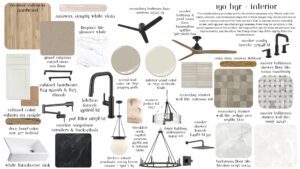
1) What is a mood board in home building, and why finalize it before we ever pour the slab?
In new construction, a mood board is your project’s North Star: a tight visual snapshot of colors, textures, materials, fixtures, and architectural cues that define the look and feel of your home—inside and out. Finalizing it early lets your builder price accurately, order lead-time items, and sequence trades without guessing at “the vibe.” In 2025, with supply variability still real in some categories, early clarity protects your budget and schedule. It also stops decision fatigue: when choices later on feel overwhelming, you return to the board and ask, “Does this selection belong to this house or not?”
2) Should I build a digital mood board or a physical one for a custom home—and when does each win?
Use both. A digital board (think Canva, Google Slides, or a shared album) is perfect for collaboration, rapid edits, and linking product pages, spec sheets, and pricing. A physical board shines during selections when touch matters—flooring planks, stone, grout, cabinet profiles, and fabrics under natural light. For builds in Alabama, bring exterior swatches outside mid-day; humidity and sun angle change how colors read on brick, siding, and trim. Your working set can be one master digital board plus a mobile “materials kit” in a portfolio case for showroom days.
3) Which 2025–2026 color directions actually belong on a new-build mood board?
Warm, grounded palettes are replacing stark, cool whites. You’ll see rich wood tones, layered neutrals, and nuanced color—think soft mauves, clay, tobacco, olive, and espresso—in kitchens, living zones, and bedrooms. Major paint brands are leaning this way: Benjamin Moore’s 2025 Color of the Year Cinnamon Slate blends heathered plum with velvety brown, a great anchor for sophisticated neutrals, while Sherwin-Williams’ 2025 choice Mauve Finery signals the same move to quietly colorful, livable hues. These directions play beautifully with hand-finished plaster, natural stone, and unlacquered brass, and they’re easier to live with than high-contrast schemes.
4) What materials and textures are trending now—and why do they matter to the build, not just the look?
Design is performance. In 2025, tactile finishes with longevity—limewash or tinted plaster, micro-textured tiles, zellige, white oak, soapstone, and honed granite—are top of mind because they wear well. Outdoor living zones are shifting to earthy palettes and natural textures (stone, clay, warm woods), which pair with durable, low-maintenance species and finishes. Choosing these early influences structural details (heavier stone tops need support), mechanical layout (makeup air for robust ranges), and site planning (stone and wood in humid Alabama require drainage and overhang strategy). Publications covering 2025 updates echo this: earthy neutrals outdoors, artisanal tile, and handmade surfaces indoors are leading the way.
5) How do home mood board ideas translate to the exterior—elevation, roof, and curb appeal?
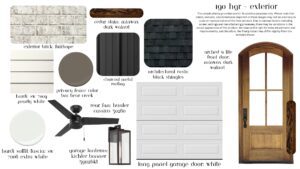
Treat the exterior as its own board: roof color and profile, primary cladding (brick, fiber-cement, stucco), secondary textures (board-and-batten, stone), window color, trim, gutters, and front door hardware. For 2025 exteriors, expect traditional forms with modern edits, sustainable materials, and bolder but grounded paint choices—especially when mixed with native landscaping and discreet solar. Your exterior board should show: a full front elevation reference, a palette stack (roof → cladding → trim → windows → door metal), lighting, house numbers, and a landscape swatch that reflects Alabama’s heat and rainfall.
6) What belongs on a kitchen mood board for a 2025 new build?
Start with the big three: cabinets (species, color, door style), counters (material, edge profile), and backsplash (scale, tile type, grout). Then add hardware, plumbing finish, lighting, flooring, and a hero image of the overall vibe. Kitchens are warming up—less clinical white, more rich woods, stone with movement, and cozy color—so build your board to show layered warmth. If you love handmade tile, include a shot with an irregular edge so installers understand you want the nuance. And tie function to finish: a family that cooks heavy needs durable counters and good ventilation; design that into the selections.
7) How do I plan bathrooms with a mood board so they feel spa-level without blowing the budget?
Limit primary surfaces to two or three, then layer texture (matte vs. honed) and scale (large format on walls, mosaic on shower pan). If you’re drawn to 2025’s statement tile trend, use it strategically—niches or a single feature wall—so labor and waste don’t spiral. Show the plumbing finish next to lighting and mirror frames to confirm your mixed-metals plan. In Alabama’s humidity, choose ventilation that fits the space; snap a photo of a quiet fan model you like and park it right on the board so it’s not value-engineered out later.
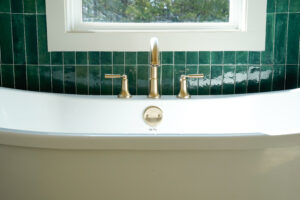
8) We want serious indoor–outdoor living—what does that look like on a board the builder can act on?
Build an outdoor board with the same discipline as your kitchen: flooring (pavers, stone, composite), ceiling (stain color, beadboard vs. v-groove), lighting, ceiling fans, screening, fireplace or firepit finish, and outdoor kitchen components. Current trends emphasize pocket sliders, outdoor kitchens 2.0, water features, and earth-tone palettes—all decisions that change framing, electrical, gas, and drainage. If mosquitoes are a factor, include a screenshot of a retractable screen system so the header and wiring get framed in day one.
9) Can mood boards really save money on a custom build—or is that wishful thinking?
They save money because they lock scope. When selections are visual and signed off, your builder can buy earlier (capturing promos), avoid re-work, and schedule trades efficiently. In 2025, with new-build pricing often more favorable than resales in many markets, a crisp board helps you maximize that advantage by steering upgrades toward impact (lighting, cabinet function, exterior focal points) and away from invisible spend. Clear boards also reduce change orders—the main budget killer on any build.
10) How do smart-home and energy feature s show up on a mood board?
Create a “systems” mini-board that includes your thermostat style, switch/keypad look, trim colors for recessed lights, EV charger location, exterior camera housings, and grille style for linear diffusers. Add an annotated plan snippet to show where you want accent lighting, under-cabinet task lighting, and landscape lighting. If you’re considering solar, battery backup, or a generator, include the enclosure photo and finish color; this keeps mechanical areas tidy and consistent with your exterior palette. Architectural trend reports continue to highlight universal design and resilience—both benefit when you treat systems as part of design up front, not an afterthought.
11) We have land. How do home mood board ideas guide a Build-On-Your-Lot project differently?
Your board should reflect the site: sun path, prevailing breezes, tree canopy, views, and approach. Show a photo of your land right on the board alongside the exterior palette and porch details; it will shape overhang depth, window placement, and outdoor room orientation (critical in the Alabama hea
t). Include a small materials map—“porch is brick herringbone; path is pea gravel; columns are square with chamfered edges”—so your field crew builds what you actually pictured.
12) How many mood boards do I need for a new build?
Use one Global Mood Board (the heartbeat of the house) and targeted boards for Exterior, Kitchen, Primary Bath, Living Core, plus on
e combined Secondary Spaces board for kids’ baths, laundry, and mudroom. That’s usually five or six boards total. Anything more risks fragmentation; anythin
g less leaves the big decisions under-defined. Keep a simple naming convention so everyone—from superintendent to tile installer—knows which board rules which space.
13) What’s the fastest way to start a board if I’m overwhelmed?
Pick one image that feels 90% right for your home—then delete anything that doesn’t harmonize with it. Next, add real selections: two cabinet colors you could buy, two counter options with thickness/edge you like, one backsplash direction, one floor. Limit to a six-to-eight tile grid on page one. Page two can be alternates. The discipline of “few, but specific” gets you moving—and keeps your builder from bidding a moving target.
14) How do I make sure my board reflects how we live, not just how it looks?
Add a one-paragraph “use case” to each board: “We host weekly Sunday dinners,” “We work from home and need acoustic privacy,” “We have a muddy baseball player and two dogs,” “We’re frequent grillers.” Then pair each with a design response: second dishwasher or larger sink, acoustic door cores and area rugs, hose bib near mudroom porch, vented outdoor kitchen with prep surface. This keeps the board honest—pretty pictures, real life.
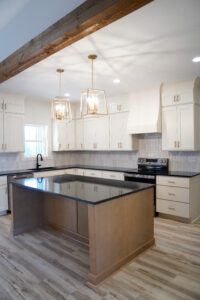
15) Mixed metals, yes or no? How do I avoid chaos in a new build?
Yes—with a plan. Pick a dominant metal (e.g., satin nickel or polished chrome) and a secondary (e.g., unlacquered brass or warm bronze). Keep door hardware and most plumbing in the dominant; allow the secondary in pendants, mirrors, and accent hardware. Use your board to show those pairings visually. If your palette leans warm (Cinnamon Slate, clay, taupe), warm metals sing; if it leans cool, stick to nickel/chrome and add warmth through wood and textiles.
16) What about current tile and surface trends—what belongs on a 2025 board and what can date a house fast?
On-trend and lasting: natural stone (honed, not glassy), handmade or handmade-look tile, textured plaster, fluted details, and wood with visible grain. Use bold or patterned tile as art, not carpet—backsplash features, a powder room wainscot, or a shower niche—so it thrills without dominating. 2025 is seeing more statement tile and art-deco-inspired geometry; keep it timeless by pairing with quiet walls and classic metals.
17) How do I board lighting so our electrician and designer are on the same page?
Create three rows: Ambient (can lights, ceiling mounts), Task (sconces at mirrors, under-cabinet tape), and Accent (pendants, chandeliers, picture lights). Add color temperature and dimming notes right on the images: “2700K throughout; dimmers on all living spaces; nightlight path in hall.” Show scale by pasting fixture images on a small snippet of the plan with dimensions. Lighting is where houses feel expensive (or cheap); a clear board ensures your fixtures match your architecture.
18) What’s the right way to mood board a kid-tough, pet-friendly new build without making it look utilitarian?
Choose beautiful and durable. Put performance fabrics, wash-and-wear rugs, and durable flooring (engineered white oak, porcelain that looks like stone) on the board right next to your pretty inspiration shots. Add practical hardware choices—soft-close hinges, full-extension drawers—and a note about where the “roughhousing zones” are so furniture and lighting are specified accordingly. If your Alabama crew loves the backyard, board a screened porch with hose-down surfaces and an easy transition to the mudroom.
19) How do I present my boards to the builder so they translate to a buildable spec?
Bring your Global Mood Board first, then walk space by space with the detailed boards. For each, confirm: finish, color, source, and “intent” (what feeling the selection serves). Leave behind a PDF set with filenames like “Kitchen_MoodBoard_v3_2025-09-01.pdf.” Ask your builder to respond with a Selections Schedule (SKU, lead time, who buys, ship-to), and attach board thumbnails. When trades see pictures and SKUs, execution tightens up.
20) We keep shifting taste. How do we keep momentum when our style is still evolving?
Give yourself one revision cycle. After the first pass, live with the boards for a week, then make final edits and freeze them. You can build flexibility into the plan (e.g., a paint-ready island that could go dark later, or a neutral tile with a changeable accent), but don’t keep changing core surfaces; that’s where schedules slip and budgets climb. If you’re torn, remember 2025’s best homes are layered and personal, not theme parks—choose honest textures, warm color, and one or two signature moves.
21) What are the most common mood board mistakes on new builds—and how do we avoid them?
-
Too many hero ideas. Pick one hero per space.
-
No “systems” board. Treat switches, vents, and cameras as design objects early.
-
Ignoring climate. Specify exterior stains, sealers, and porch materials that handle humidity.
-
Forgetting scale. That massive lantern might dwarf your entry—paste it on a plan.
-
Not documenting decisions. If it’s not on the board or in the selections schedule, it’s up for debate later.
22) What’s a smart “starter kit” for home mood board ideas if we want momentum by this weekend?
-
Choose your Global inspiration image. 2) Pick your wood tone, stone/counter , and metal stack. 3) Add your paint triad: main walls, trim/doors, accent. 4) Drop in two lighting references and one textile that embodies the feel. 5) Create separate pages for Exterior, Kitchen, Primary Bath, and Outdoor Living with two locked options each. On Monday, send PDFs to your builder; ask for a selections meeting date and a preliminary schedule.
Why These Home Mood Board Ideas Matter
Your home is more than walls and a roof—it’s the place where your family’s story unfolds. Asking the right questions helps you find a builder who understands that. At TBG Homes, we believe families deserve honesty, craftsmanship, and homes built to last. Whether you’re ready to break ground or just starting your search, asking bold questions is the best first step toward the home you’ve always wanted. Too often, families rush into a decision without fully exploring their options, and that can lead to regrets down the road. When you know what to ask, you put yourself in control of the process—not the other way around. The right builder should make you feel confident, supported, and excited about the journey, not overwhelmed. These questions aren’t just about houses; they’re about building a future that fits your lifestyle and your dreams. And when you partner with a builder who values those things as much as you do, the result is a home that feels truly yours from day one.